Initial Market: Alcon Quality Testing
PartiClear's primary market is Alcon's internal quality testing workflow for phacoemulsification handpieces. Since the system was developed in response to Alcon's production need, the initial implementation strategy focuses on supporting existing particulate shedding tests rather than entering a broad consumer or clinical market.
In this setting, the value of PartiClear comes from reducing manual scanning burden, improving consistency in particulate counting and measurement, and supporting a more streamlined pass/fail reporting process.
Market Strategy: Internal Adoption First
PartiClear would first be implemented as an internal quality testing support tool within Alcon's manufacturing workflow. Rather than replacing quality personnel, the system is designed to assist operators by automating repetitive slide scanning, particulate detection, measurement, and report generation. This phased strategy allows the device to be validated against current manual testing methods before broader use.
Competitor Analysis
Comparing particulate inspection approaches across speed, consistency, scalability, automation, and cost.
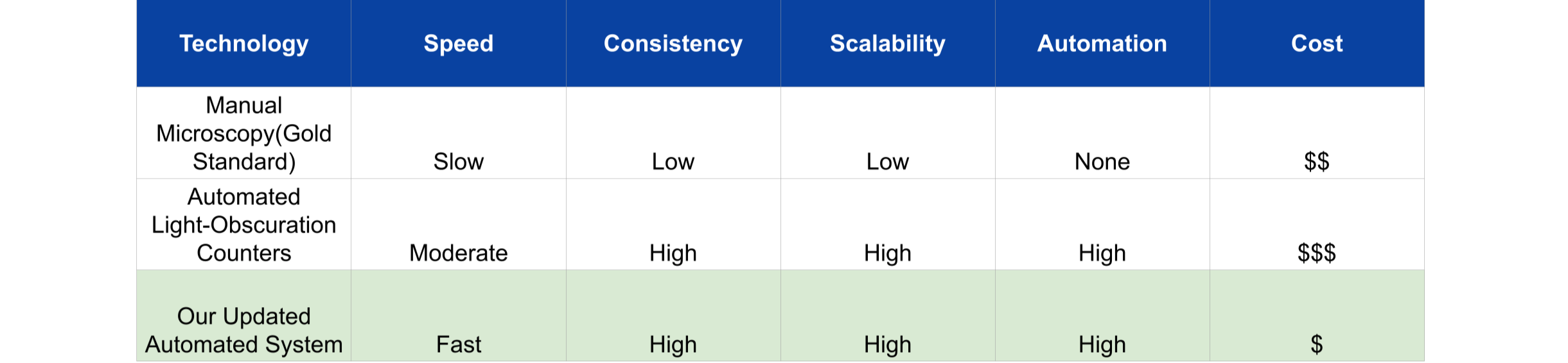
Manual microscopy remains the current gold standard for particulate inspection, but it is slow, operator-dependent, and difficult to scale for high-volume production. Automated light-obscuration counters improve speed and consistency, but they can be costly and may not be tailored to image-based titanium particulate identification. PartiClear was designed to address this gap by combining automated slide scanning, machine learning-based detection, and particulate measurement in a lower-cost system built around Alcon's quality testing workflow.
Future Applications
Although PartiClear was designed for Alcon's handpiece production workflow, the core system could be adapted to other microscopy-based inspection tasks. Because the platform combines controlled stage movement, image capture, machine learning detection, and measurement, it may be useful for other applications that require consistent identification and quantification of small particles or defects.